Overlapping Spectrum Conditions and the ALPIMS Framework
Many families discover that health conditions do not occur in isolation.
Instead, they often appear in clusters that share common underlying sensitivities.
In our family, these have included:
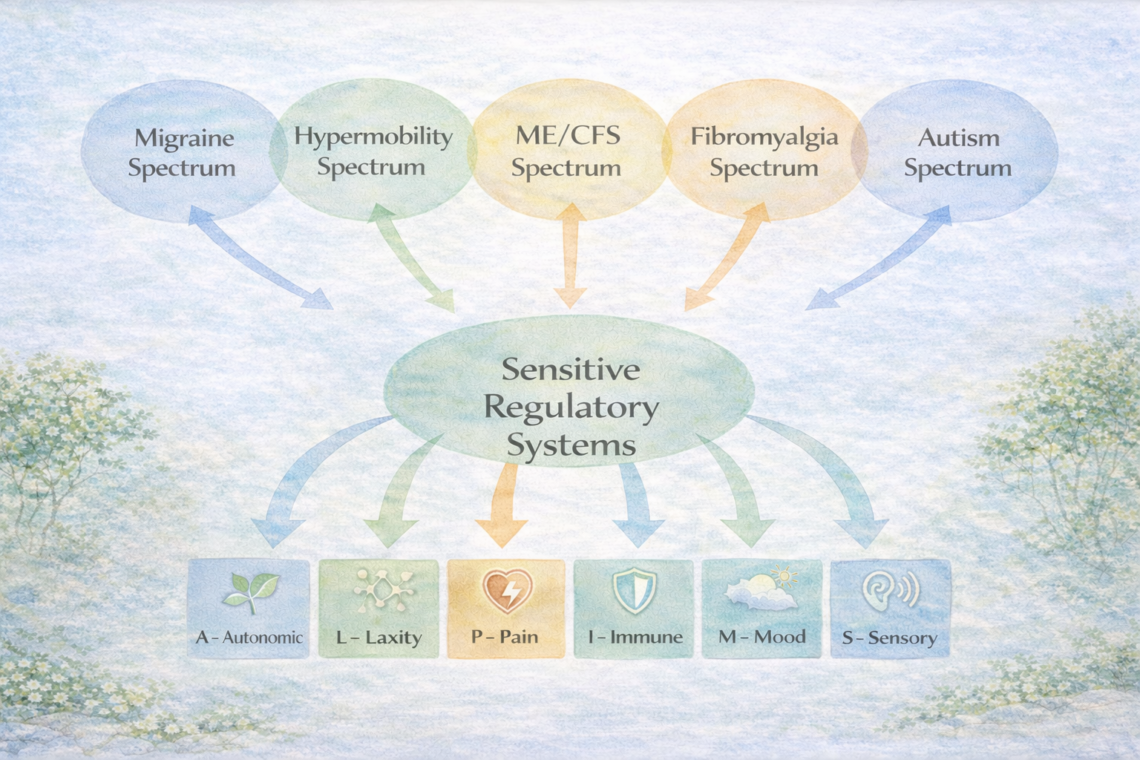
- Migraine spectrum disorder
- Hypermobility spectrum disorder
- ME/CFS spectrum disorder
- Fibromyalgia spectrum disorder
- Autism spectrum disorder
At first these diagnoses can feel unrelated. But over time it becomes clear that they often affect similar regulatory systems in the body.
This is where the ALPIMS framework can be helpful.
What the ALPIMS Framework Describes
ALPIMS looks at six interacting regulatory domains:
A – Autonomic / Anxiety regulation
L – Laxity (connective tissue and structural regulation)
P – Pain processing
I – Immune and inflammatory regulation
M – Mood and energy regulation
S – Sensory processing
Instead of focusing on one condition at a time, the framework recognises that many people experience sensitivities across several of these systems simultaneously.
When one domain becomes stressed, it can affect the others.
How Spectrum Conditions Map to ALPIMS
Many of the conditions our family lives with sit across several ALPIMS domains.
Migraine Spectrum
Often involves:
- Pain processing
- sensory hypersensitivity
- autonomic changes
- immune and inflammatory triggers
ALPIMS domains involved: P, S, A, I
Hypermobility Spectrum
Common features include:
- connective tissue laxity
- autonomic dysregulation (such as POTS)
- chronic pain
- fatigue
ALPIMS domains involved: L, A, P
ME/CFS Spectrum
Often involves:
- autonomic dysregulation
- immune activation
- profound fatigue and energy instability
- sensory sensitivity
ALPIMS domains involved: A, I, M, S
Fibromyalgia Spectrum
Typically includes:
- central pain sensitisation
- sensory amplification
- fatigue
- mood and sleep regulation changes
ALPIMS domains involved: P, S, M
Autism Spectrum
While autism is a neurodevelopmental difference rather than an illness, many autistic people experience differences in:
- sensory processing
- autonomic regulation
- immune responses
- pain perception
ALPIMS domains involved: S, A, I, P
Why These Conditions Often Overlap
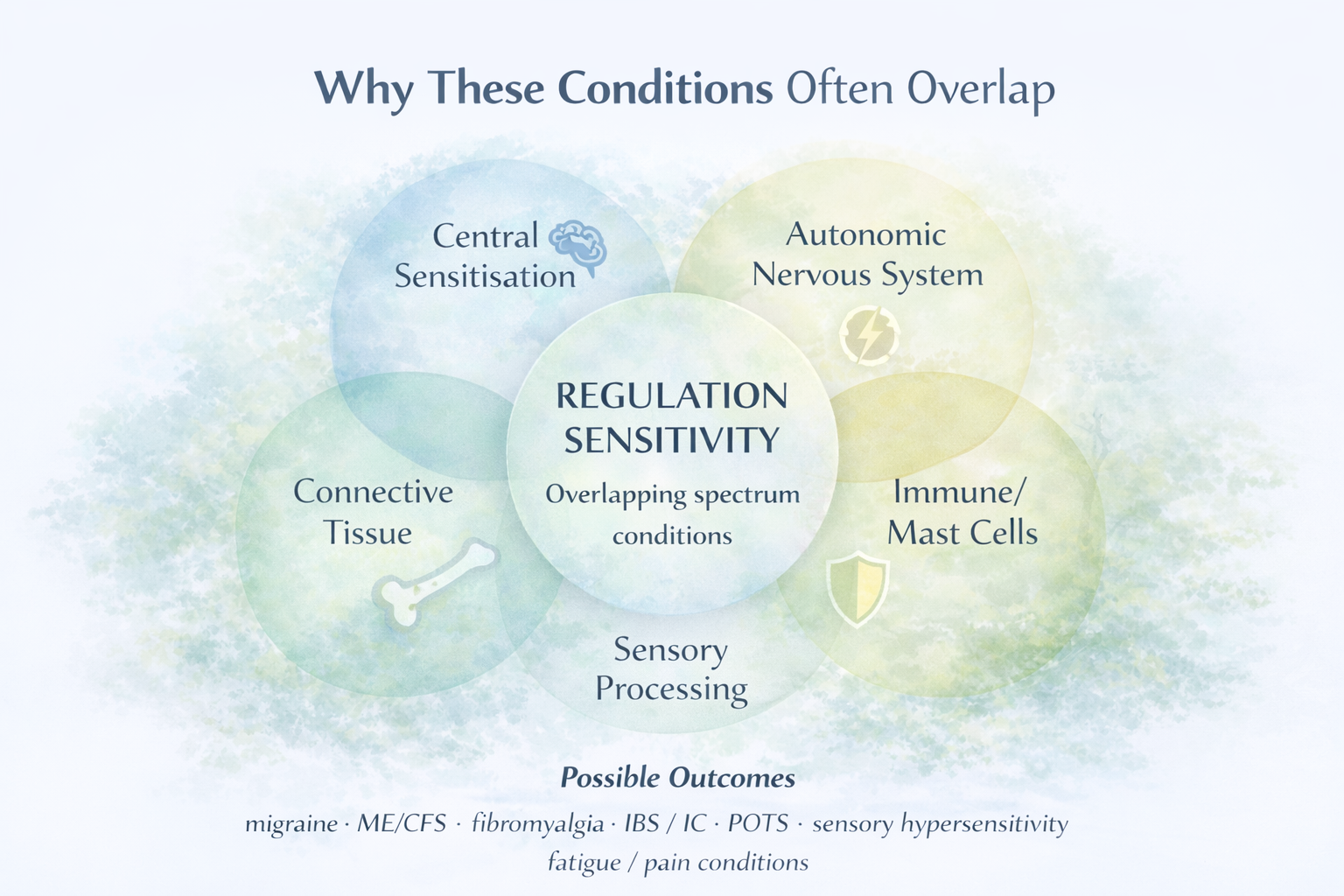
Researchers increasingly recognise that many of these conditions share mechanisms such as:
- central sensitisation
- autonomic nervous system dysregulation
- connective tissue differences
- immune activation or mast cell involvement
- sensory processing differences
When these systems interact, a person may develop several overlapping diagnoses across their lifetime.
This does not mean something new is going wrong each time.
Often it reflects different expressions of the same underlying regulatory sensitivities
.
How the ALPIMS Framework Can Help
The ALPIMS framework can help families in several practical ways.
1. Seeing the Whole Pattern
Instead of treating each condition as separate, ALPIMS helps identify shared patterns across symptoms.
This can reduce confusion and repeated diagnostic searching.
2. Supporting the Whole System
Strategies can then focus on supporting regulation across multiple domains, such as:
- pacing energy and reducing overload
- supporting sleep and nervous system recovery
- reducing sensory and environmental load
- stabilising nutrition and inflammation
- managing stress and emotional load
Small improvements in one area often support the others.
3. Reducing Blame and Confusion
Families living with overlapping conditions often feel misunderstood.
A framework like ALPIMS helps explain that these experiences may reflect a sensitive regulatory system, rather than weakness or lack of effort.
4. Supporting Practical Self-Management
Many people find it helpful to use familiar condition management strategies such as those used for:
- migraine
- asthma and allergy
- chronic fatigue pacing
and apply them across multiple ALPIMS domains.
A Simple Way to Think About It
One way to imagine ALPIMS is as a set of interconnected control systems in the body.
When several systems are sensitive, they can influence each other:
- sensory overload can increase pain
- immune activation can worsen fatigue
- poor sleep can increase autonomic instability
- connective tissue laxity can affect nervous system regulation
By supporting regulation across the system, many people find that overall symptom load becomes more manageable, even if the conditions themselves remain.
A Gentle Note
The ALPIMS framework is a way of understanding patterns, not a medical diagnosis.
Everyone’s situation is different.
This site shares lived experience, observations, and resources that helped our family better understand overlapping sensitivities.
Take what helps, and leave the rest.