Central Sensitisation and ALPIMS
Some long-term health conditions appear to involve changes in how the nervous system processes signals.
This process is often referred to as central sensitisation.
Conditions sometimes associated with central sensitisation include:
- ME/CFS
- Migraine
- Fibromyalgia
- Irritable Bowel Syndrome (IBS)
- Interstitial Cystitis / Painful Bladder Syndrome (IC/PBS)
- TMJ
These are sometimes referred to as Central Sensitivity Syndromes (CSS) orChronic Overlapping Pain Conditions. (COPC’s)
In recent years, researchers have proposed that some people experience these conditions not as a single illness, but as a cluster of overlapping regulatory sensitivities affecting multiple body systems.
One way this has been described is through the ALPIM Syndrome, which includes the domains:
- Anxiety
- Laxity
- Pain
- Immune
- Mood
When we looked at our family’s experience, this idea made sense.
However, we adapted it slightly for our own framework.
We found two additional areas were very important:
- Autonomic regulation (how the body controls heart rate, breathing, and stress responses)
- Sensory overload (sensitivity to light, sound, smell, touch, and internal sensations)
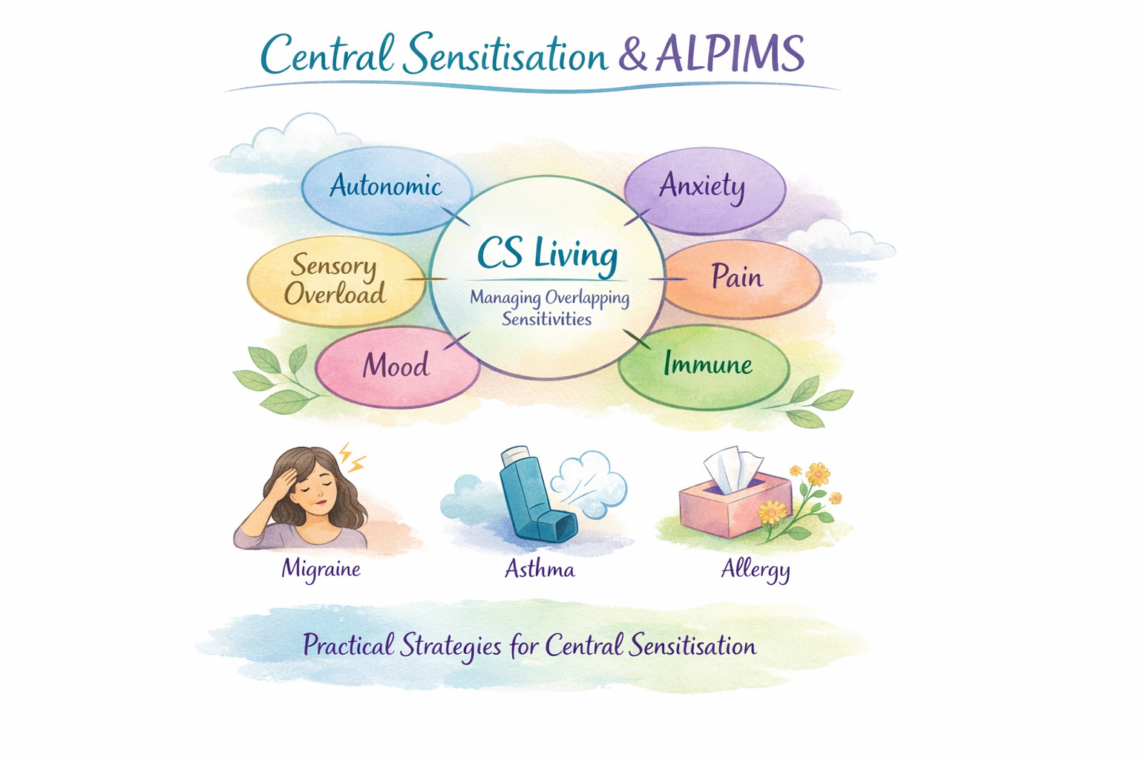
This became our ALPIMS framework:
Autonomic • Laxity • Pain • Immune • Mood • Sensory
In our family, different members experienced different health challenges.
The ALPIMS framework helped us understand these overlaps and manage them more practically.
Rather than focusing on one diagnosis at a time, the framework helps us understand how multiple systems can interact and influence symptoms.
                    PAIN
      Migraine • Fibromyalgia • TMJ
                     │
                     │
AUTONOMIC ─────── CENTRAL SENSITISATION ─────── SENSORY
ME/CFS (Nervous System) Sensory hypersensitivity
POTS Visual Snow
Misophonia
Hyperosmia
                     │
                     │
                    MOOD
            Stress sensitivity
                 Anxiety


                    IMMUNE
          MCAS • Allergy • Asthma


                    LAXITY
               Hypermobility
A Practical Bridge: Migraine, Asthma and Allergy Management
One of the most helpful things we discovered was that strategies used for migraine, asthma, and allergy managementoften overlap with approaches used for central sensitisation.
These approaches can include:
- Reducing overall sensory and environmental load
- Supporting sleep and recovery
- Improving nutrition and hydration
- Learning pacing and energy management
- Stabilising the nervous system
These strategies do not fix everything, but they can help reduce the frequency and intensity of symptoms for some people.
For simplicity, we refer to this approach as:
“CS Living” — learning practical ways to live with central sensitisation while gradually rebuilding capacity.
Learn More
If you would like to explore these topics further, these pages explain them in more detail:
- Central Sensitisation Overview
- Environmental Sensitivity and Regulation
- The ALPIMS Framework
- Load and Capacity Model
- Migraine as a Regulation Bridge
- Asthma and Allergy Strategies
- Nervous System Regulation Tools
- Functional Neurological Disorder
- Central Sensitisation, FND and Trauma Overlaps
- Neurodivergence Link
- Burnout Tools
A Small Note
This site shares lived experience and practical strategies that helped our family.
It is not medical advice and may not apply to everyone.
Take what is helpful and leave the rest.