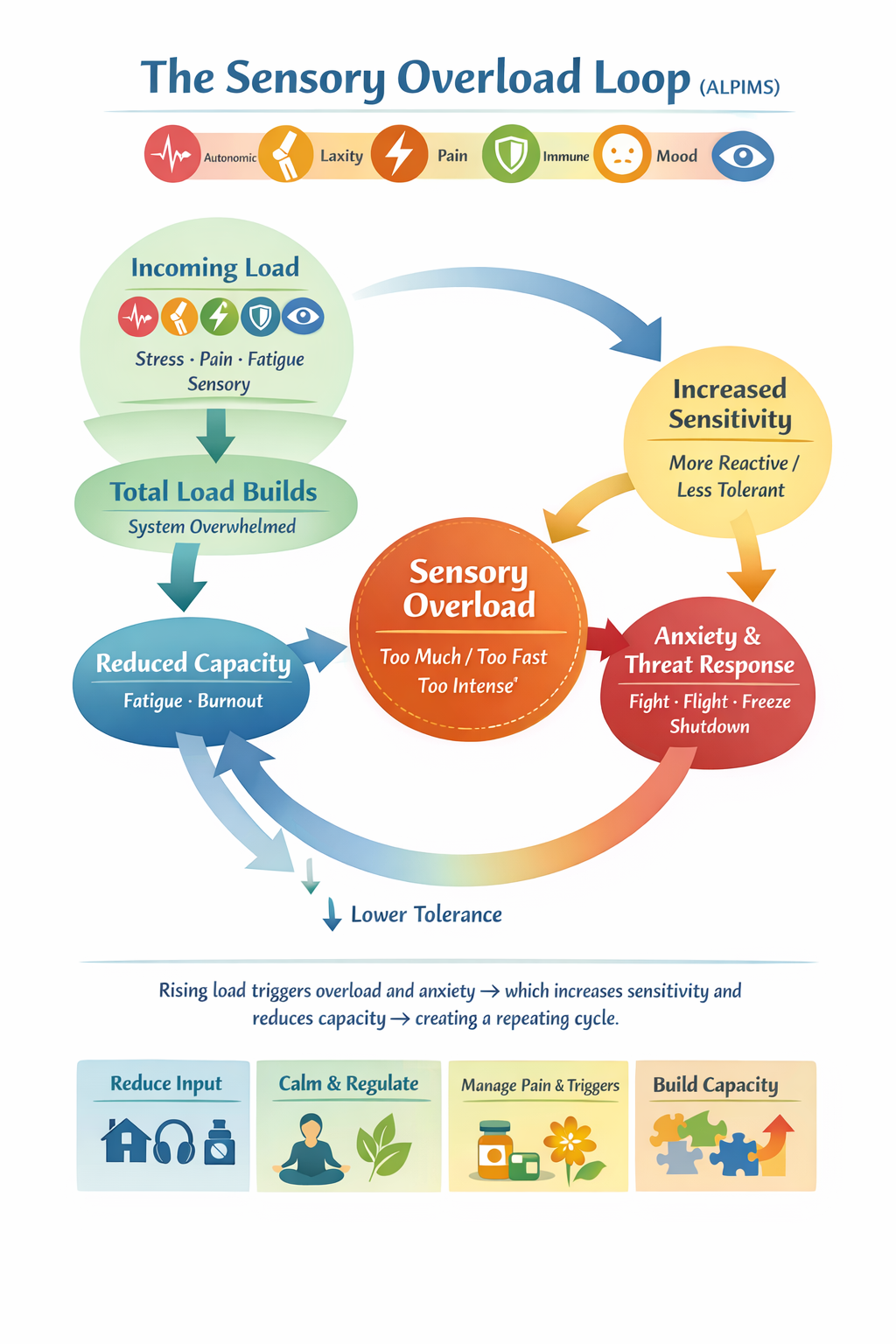
Load builds → overload → sensitivity increases → tolerance drops → repeat
This website provides educational information and personal perspectives only. It is not medical advice and should not replace consultation with qualified health professionals
What is Sensory Overload?
Sensory overload happens when the brain and body receive more input than they can process comfortably.
This can include:
- sound (multiple voices, background noise)
- light (bright, flickering, busy environments)
- smell (fragrance, chemicals, food)
- touch (clothing, crowding, temperature)
- movement (busy environments, motion)
- internal signals (pain, fatigue, hunger)
When load exceeds capacity:
- the brain can’t filter input
- everything feels stronger
- thinking becomes harder
The body may respond with:
- fight (irritability)
- flight (urge to escape)
- freeze (stuck)
- shutdown (exhaustion)
How ALPIMS Domains Contribute
Sensory overload is not just sensory — it involves the whole system, and may span multiple domains
A — Autonomic
- stress response activates quickly
L — Laxity
- physical effort and fatigue reduce capacity
P — Pain
- increases sensitivity to input
I — Immune
- reactions to environment and chemicals
M — Mood
- anxiety lowers tolerance
S — Sensory
- difficulty filtering input
Together, these create total load
▶️ Why It Feels So Intense
Why It Feels So Intense
When load exceeds capacity:
- the brain can’t filter input
- everything feels stronger
- thinking becomes harder
The body may respond with:
- fight (irritability)
- flight (urge to escape)
- freeze (stuck)
- shutdown (exhaustion)
Common Signs
Body
- tension, fatigue, nausea
Brain
- foggy thinking
- trouble concentrating
Emotions / behaviour
- anxiety or panic
- irritability
- withdrawal or shutdown
The brain is always filtering information.
When overwhelmed, it becomes harder to:
- ignore unimportant input
- focus clearly
- stay regulated
This is sometimes called reduced sensory filtering
Conditions Commonly Linked
Sensory overload is more common in:
- allergies, MCAS, chemical sensitivity
- autism
- ADHD
- PTSD and anxiety
- migraine
- ME/CFS and fibromyalgia
- Misophonia
- sensory sensitivities
What Helps
Reduce load
- quieter spaces
- softer lighting
- fragrance-free environments
Support regulation
- rest before overload
- breathing, calming tools
- predictable routines
See: Nervous System Regulation Ladder. and 10 Everyday Tools
Manage internal load
- pain support
- allergy and trigger management
- pacing
see Focus timers
Build capacity gradually
- small exposures
- spacing activities
- avoiding push–crash cycles
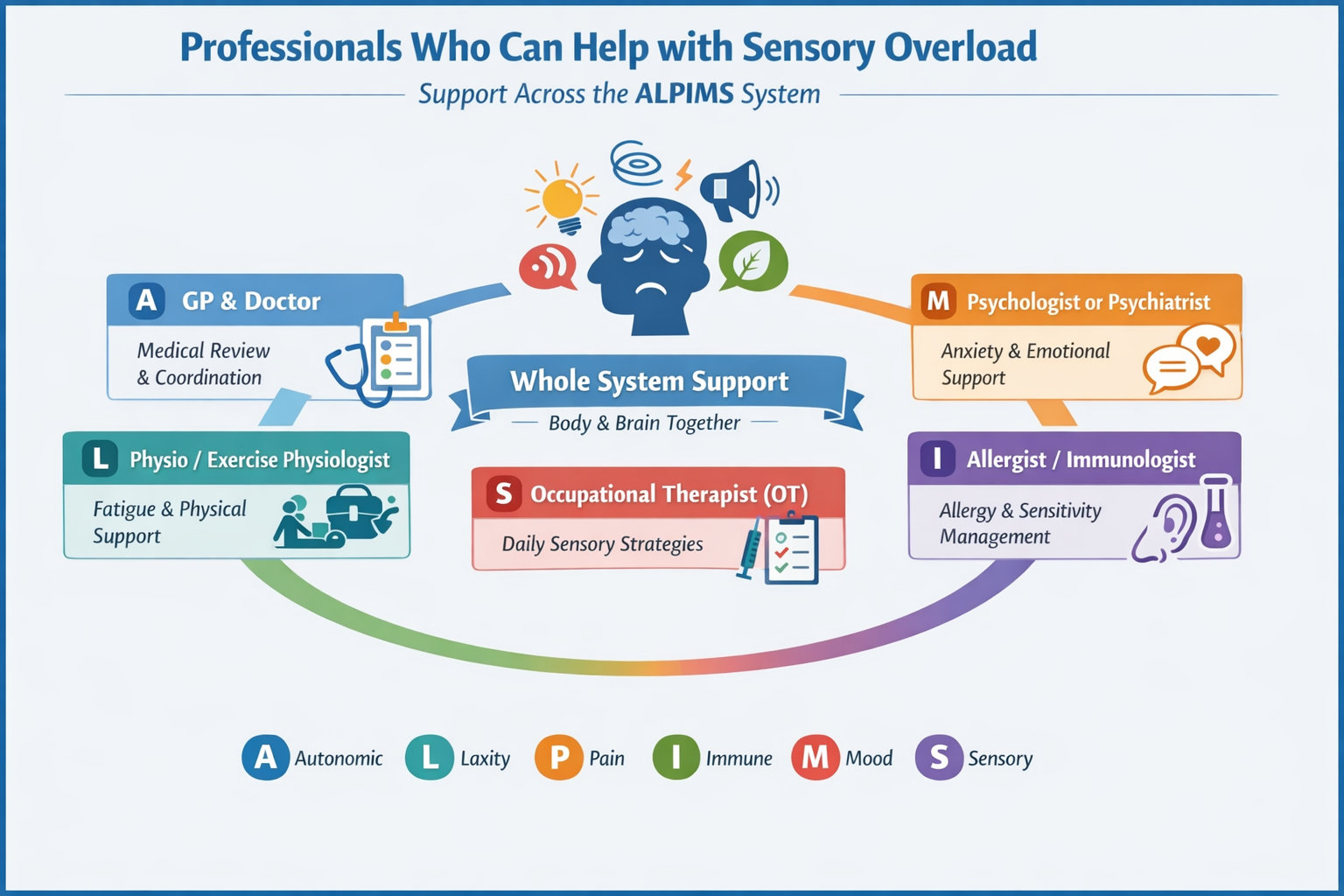
Occupational Therapist (OT)
Best for: everyday sensory challenges
Helps with:
- identifying triggers
- sensory strategies (e.g. calming tools, routines)
- home, school, or work adaptations
Often the most practical starting point
Psychologist (Trauma-Informed / Neurodivergent-Aware)
Best for: anxiety, overwhelm, trauma
Helps with:
- managing anxiety and panic
- understanding shutdowns or meltdowns
- reducing fear around symptoms
Important if overload is linked to stress or PTSD
GP (General Practitioner)
Best for: coordination and medical review
Helps with:
- ruling out medical causes
- referrals to specialists
- medication support if needed
Your central coordinator
Neurologist
Best for: migraine, nervous system conditions
Helps with:
- migraine management
- sensory sensitivity linked to neurological conditions
Psychiatrist
Best for: complex mood or anxiety conditions
Helps with:
- medication for anxiety, sleep, mood
- managing severe overwhelm or shutdown
Allergist / Immunologist
Best for: immune and chemical sensitivities
Helps with:
- allergies, MCAS, environmental triggers
- reactions to smells, foods, environments
Cardiologist / POTS Specialist
Best for: autonomic symptoms
Helps with:
- dizziness, heart rate issues
- faintness or overload in busy environments
Physiotherapist / Exercise Physiologist
Best for: body load and fatigue
Helps with:
- pacing physical activity
- reducing strain from hypermobility or fatigue
- improving physical tolerance
Dietitian (Experienced in Sensitivities)
Best for: food-related triggers
Helps with:
- identifying food sensitivities
- avoiding unnecessary restriction
- maintaining nutrition
Audiologist
Best for: sound sensitivity
Helps with:
- hyperacusis (sound sensitivity)
- misophonia support strategies
ENT Specialist
Best for: sinus, smell, or ear issues
Helps with:
- chronic sinus problems
- smell sensitivity
- ear-related triggers
How This Links to ALPIMS
Different professionals support different domains:
- A (Autonomic): GP, cardiologist, psychologist
- L (Laxity): physiotherapist
- P (Pain): GP, neurologist
- I (Immune): allergist/immunologist
- M (Mood): psychologist, psychiatrist
- S (Sensory): occupational therapist, audiologist
Sensory overload improves most when multiple domains are supported together
Key Message
You are not “too sensitive”
Your system may just need the right type of support
Gentle Guidance
If you’re unsure where to start:
Start with:
- GP (to guide)
- Occupational Therapist (for practical strategies)
Then build support based on your needs.
References
- APA – Anxiety and stress response
- Neurodiversity and neurodivergence https://www.healthdirect.gov.au/neurodiversity-and-neurodivergence
- https://www.psychologytoday.com/au/basics/sensory-processing-disorder
- CDC – Chronic illness and nervous system regulation
- Woolf CJ – Central sensitisation
- https://my.clevelandclinic.org/health/articles/4062-chronic-illness
- Sensory Overload Wikipedia https://en.wikipedia.org/wiki/Sensory_overload
- Aspect https://www.aspect.org.au/resource-library/sensory-needs
- .Sensory Processing Disorders in Children and Adolescents: Taking Stock of Assessment and Novel Therapeutic Tools. Brain Sci. 2022 Oct 31;12(11):1478. doi: 10.3390/brainsci12111478. PMID: 36358404; PMCID: PMC9688399.