In our family we noticed several different health conditions appearing across family members.
Some of these included:
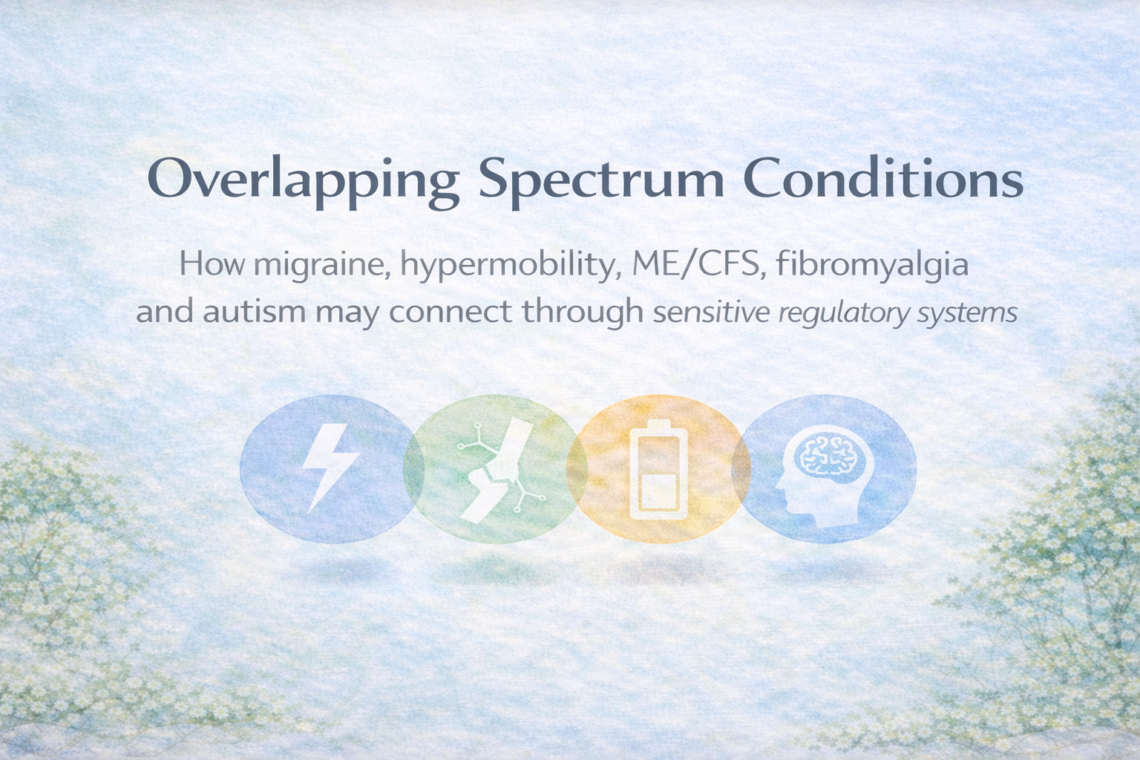
- Migraine spectrum
- Hypermobility spectrum
- ME/CFS spectrum
- Fibromyalgia spectrum
- Autism spectrum
At first these diagnoses seemed unrelated.
But over time we noticed many similar patterns of symptoms, including fatigue, pain, sensory sensitivity, nervous system overload, and fluctuating health.
This made us wonder whether something underneath these conditions might be connected.
How These Spectrum Conditions May Connect
Different spectrum conditions in our family appeared to connect through sensitive regulatory systems described in the ALPIMS framework.
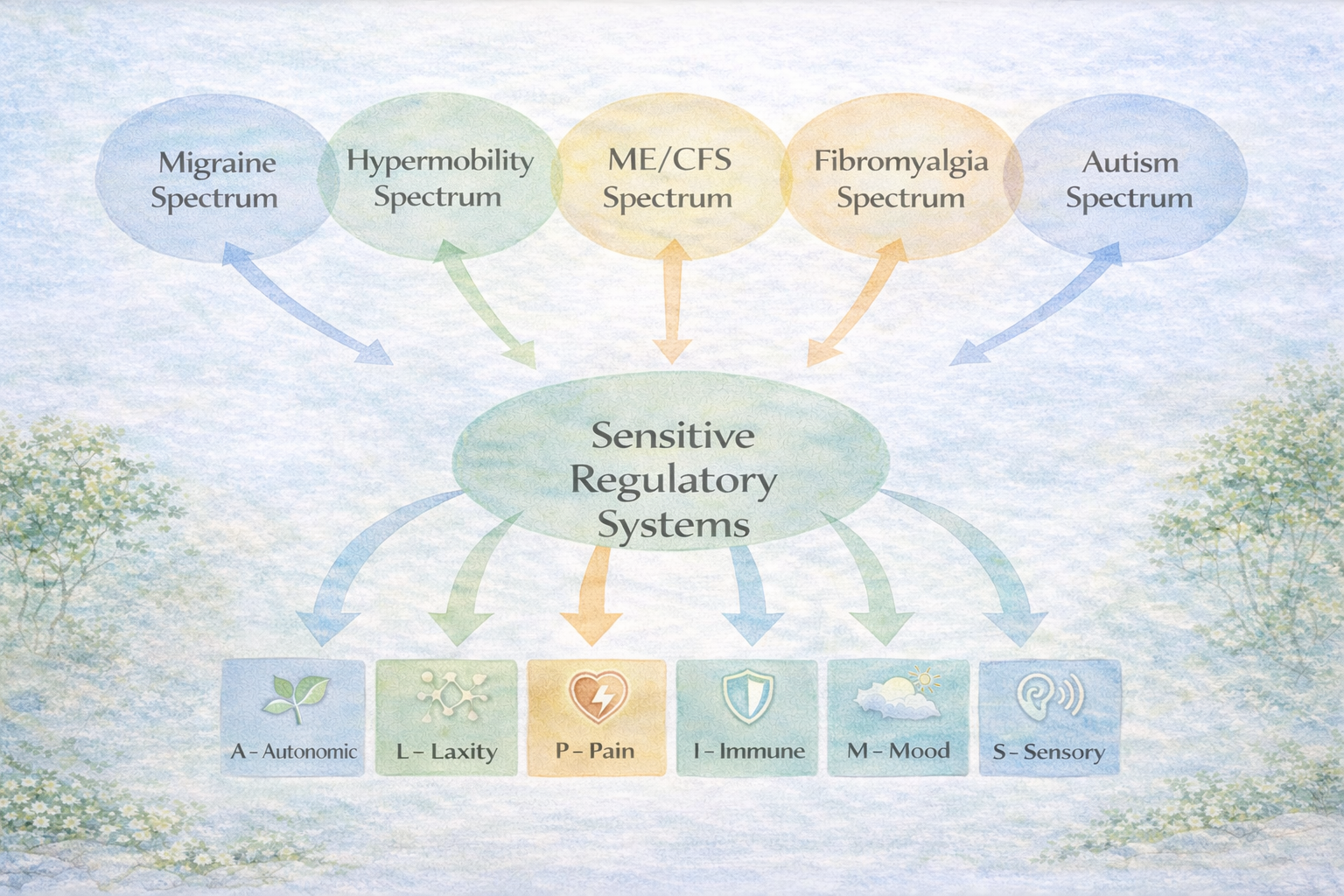
The diagram above shows a simple idea that helped us make sense of what we were seeing.
Across our family we saw different spectrum conditions, but many of the underlying sensitivities seemed similar.
Sensitive Regulatory Systems
In the centre of the diagram are sensitive regulatory systems in the body.
These systems help regulate things like:
- the nervous system
- connective tissue
- immune responses
- pain signalling
- mood and stress responses
- sensory processing
When these systems are more sensitive, the body may react more strongly to things such as:
- stress
- activity
- illness
- sensory input
- environmental triggers
This can sometimes appear as different spectrum conditions in different people.
The ALPIMS Framework
To help describe these systems we use the ALPIMS framework.
ALPIMS looks at six areas of regulation in the body:
A — Autonomic regulation
How the nervous system responds to stress, activity, and environment.
L — Laxity
Connective tissue differences that can affect joints, circulation, and body stability.
P — Pain processing
How the nervous system processes pain signals.
I — Immune activity
Inflammation, allergies, mast cell responses, and immune regulation.
M — Mood regulation
How the brain responds to emotional and physiological stress.
S — Sensory processing
How the brain processes sensory input such as light, sound, smell, and touch.
Looking at symptoms through these systems helped us understand why different diagnoses in our family sometimes felt connected.
Where the Idea Came From
The idea behind ALPIMS was influenced by research in 2015 that proposed a pattern called ALPIM syndrome (Anxiety, Laxity, Pain, Immune, Mood).
In our family we found it helpful to expand this slightly to include sensory processing and autonomic regulation, which seemed to play an important role in our symptoms.
Why Spectrum Conditions Sometimes Overlap
Many spectrum conditions involve several of these regulatory systems at once.
For example:
Migraine spectrum often involves sensory processing, pain signalling, and autonomic nervous system sensitivity.
Hypermobility spectrum involves connective tissue differences, pain processing, and autonomic regulation.
ME/CFS spectrum often affects energy regulation, autonomic function, immune activity, and sensory processing.
Fibromyalgia spectrum involves pain processing, sensory sensitivity, and nervous system overload.
Autism spectrum often involves differences in sensory processing and nervous system regulation.
Because these systems interact with each other, symptoms can sometimes appear across several spectrum conditions.
Why We Share This
This site shares the insights we have learned while navigating these patterns in our own family.
Alongside information about spectrum conditions and the ALPIMS framework, you will also find:
- simple insights that helped reduce overload
- small strategies that improved daily life
- recipes and routines that supported our health
- reflections from our family journey
Our hope is that these experiences may help others recognise similar patterns in their own lives.
A Gentle Note
The ideas on this site are based on lived experience and emerging research into overlapping spectrum conditions.
The ALPIMS framework and ALPIM spectrum are evolving concepts intended to help describe patterns across regulatory systems. They are not currently formal medical diagnoses.
If symptoms are persistent or concerning, speaking with a healthcare professional is important.