Central Sensitisation, FND, and Trauma
Trying to understand a nervous system that feels “too sensitive”
When symptoms first started appearing in our family, we were given many different explanations.
Some doctors talked about central sensitisation.
Others mentioned functional neurological disorder (FND).
Sometimes trauma was raised as a possible factor.
At first this was confusing. It felt like we were being given different stories for the same symptoms.
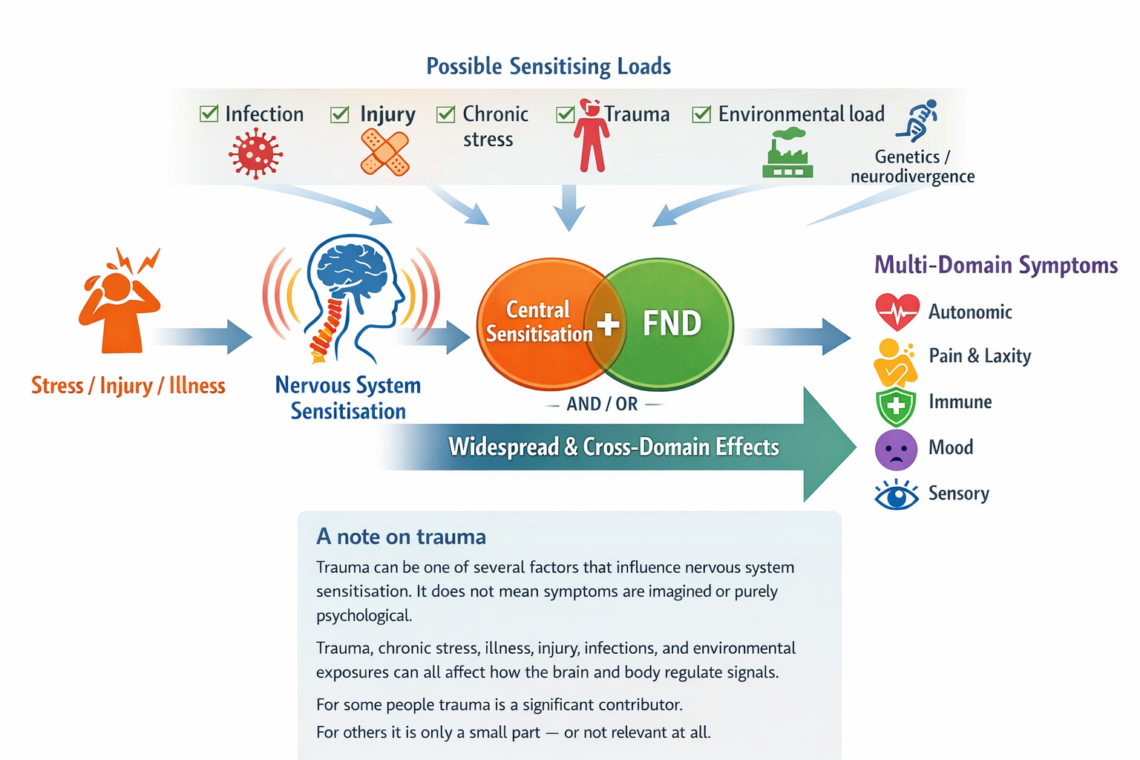
Over time, I came to see that these explanations are often describing different aspects of the same underlying problem — a nervous system that has become highly sensitive and easily overwhelmed.
Understanding this changed how I thought about symptoms, and how we tried to manage them.
Central Sensitisation
When the volume dial gets turned up
Central sensitisation describes a situation where the brain and spinal cord become more reactive to signals from the body.
Instead of filtering signals normally, the nervous system starts to amplify them.
Things that might once have been mildly uncomfortable can begin to feel overwhelming.
For some people this shows up as:
• Widespread pain
• Migraine or chronic headaches
• Sensitivity to light or noise
• Smell sensitivity
• Fatigue and brain fog
• Lower tolerance for stress or stimulation
It can feel as if the volume dial for the whole nervous system has been turned up too high.
Many conditions are thought to involve this pattern, including fibromyalgia, migraine, irritable bowel syndrome and some chronic fatigue syndromes.
Functional Neurological Disorder (FND)
When the signal itself misfires
Functional Neurological Disorder is slightly different.
In FND the problem is not that signals are louder, but that the brain sometimes struggles to coordinate or send signals correctly.
People may experience symptoms such as:
• Tremor or abnormal movements
• Weakness or paralysis
• Non-epileptic seizures
• Speech or vision changes
• Unusual sensory symptoms
Tests may look normal because the brain itself is not damaged.
Instead, the issue is with how brain networks are communicating.
A simple way to think about it is that the software controlling the system has become disrupted, even though the hardware is intact.
Where Trauma Fits In
Trauma is sometimes discussed alongside these conditions.
But trauma is only one possible influence on the nervous system, not the whole story.
In our experience, and in many others, the nervous system can become sensitive for many different reasons.
Possible contributors include:
• physical injury
• illness or infection
• chronic stress
• sensory overload
• environmental pressures
• genetic vulnerability or neurodivergence
• trauma
For some people trauma plays a large role.
For others it may be a smaller piece of the puzzle — or not relevant at all.
What seems to matter most is the overall load placed on the nervous system over time.
Looking at it through a load and capacity lens
One idea that helped me make sense of things is the load and capacity model.
Our nervous system has a certain amount of capacity to regulate stress, sensory input, pain signals, and immune activity.
When life repeatedly pushes beyond that capacity — through illness, stress, or overload — the system can become more reactive and less resilient.
Symptoms then start appearing across multiple systems at once.
For example:
• heart rate and blood pressure regulation
• pain signalling
• immune responses
• mood stability
• sensory tolerance
When this happens it can feel like everything is going wrong at once, even though the underlying issue may be the nervous system struggling to regulate.
How this fits with the ALPIMS framework
When I began mapping symptoms across our family, I noticed they tended to fall into six broad areas:
Autonomic
Laxity
Pain
Immune
Mood
Sensory
This became the ALPIMS framework.
Both central sensitisation and FND can influence several of these domains at once.
That helps explain why people with complex chronic conditions often experience multiple seemingly unrelated symptoms.
What helped shift things
For a long time I searched for one single cause that would explain everything.
But improvement rarely came from one dramatic solution.
Instead, it came from many small adjustments that helped the nervous system settle.
Things like:
• reducing sensory overload
• pacing activity more carefully
• improving sleep and routine
• supporting nutrition and hydration
• calming the nervous system
• gradually rebuilding tolerance
None of these were instant fixes.
But together they helped increase capacity and reduce sensitivity over time.
A final thought
If there is one thing I wish I had understood earlier, it is this:
When the nervous system becomes highly sensitive, symptoms can appear in many different forms.
Pain, fatigue, sensory overload, neurological symptoms — they may look unrelated, but sometimes they are all part of the same regulation problem.
Understanding that made the situation feel less mysterious — and a little less frightening.
And it opened the door to focusing not just on symptoms, but on supporting the nervous system itself.