Understanding the Connection
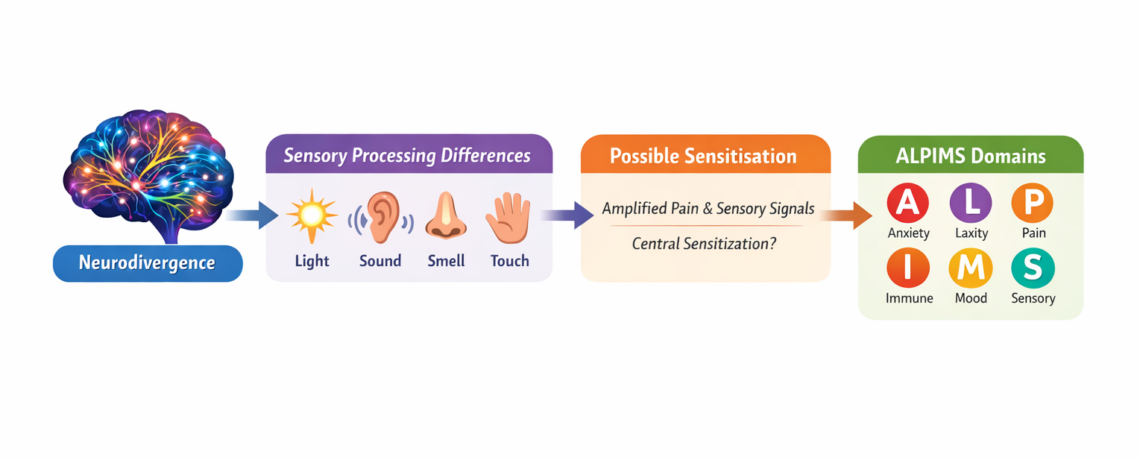
This diagram reflects something I gradually began to understand about my own experience and the experience of some members of our family.
For many years our symptoms looked like a collection of unrelated problems — sensory overload, migraine, fatigue, pain, immune reactions, anxiety, and environmental sensitivities.
Over time it became clearer that these experiences might actually be connected through how our nervous systems process information and sensory input.
1. Neurodivergence
Neurodivergence describes natural differences in how the brain works.
In our family this often meant brains that were:
• very aware of patterns
• deeply focused on interests
• highly sensitive to sensory input
• strongly responsive to the environment
This sensitivity can bring strengths — creativity, empathy, curiosity, and the ability to notice things others might miss.
But it can also mean the nervous system takes in a lot of information from the world, sometimes more than it can comfortably process.
Learn more about Neurodivergence
Giftedness and Intensity
Some neurodivergent people are also gifted or highly intellectually curious.
Giftedness can bring wonderful strengths — deep thinking, creativity, curiosity, and the ability to see patterns and connections quickly.
However, it can also come with intensity of thinking, emotion, and sensory awareness. The brain may process information very quickly and notice many details at once.
When life becomes stressful, busy, or overwhelming, this intensity can increase the overall load on the nervous system.
2. Sensory Processing Differences
For some of us this meant the world could feel a little louder, brighter, or stronger than it did for other people.
Things like:
• strong smells
• busy environments
• bright lights
• constant noise
• certain fabrics or textures
could quickly become overwhelming.
At first we thought this meant something was wrong.
Later we realised it might simply mean our sensory systems were tuned more sensitively.
3. Possible Sensitisation
However, when a sensitive nervous system experiences long periods of stress, illness, overload, trauma, or inflammation, it may become even more reactive.
This process is sometimes described as sensitisation.
Signals that the body normally manages easily can start to feel much stronger.
Pain can increase.
Sensory tolerance can drop.
Fatigue and brain fog can appear.
For some people this pattern overlaps with what researchers call central sensitisation, which is seen in conditions like migraine, fibromyalgia, and chronic fatigue patterns.
4. How the ALPIMS Framework Helps
The ALPIMS framework helped me understand why so many symptoms seemed connected.
Instead of separate problems, they often appeared across several regulation systems at once.
ALPIMS describes these systems as:
A – Anxiety / Autonomic
stress responses, dysautonomia patterns like POTS
L – Laxity
joint hypermobility and connective tissue differences
P – Pain
migraine and central sensitisation patterns
I – Immune
allergies, mast cell activation, inflammation
M – Mood
burnout and emotional overwhelm
S – Sensory
light, sound, smell, and touch sensitivity
When one system becomes overloaded, it can influence the others.
A perspective that helped me
One of the most helpful shifts for me was realising that my body was not failing.
It was reacting to load.
A nervous system that processes the world intensely can sometimes become overwhelmed — but it can also stabilise when the load is reduced and capacity is rebuilt.
Instead of trying to fix every individual symptom, we began focusing on supporting the whole system.
Small changes in environment, pacing, sleep, nutrition, and stress regulation started to make more sense.
Closing reflection
This framework does not explain every experience, and it will not apply to everyone.
But for our family it helped connect pieces that once felt confusing and overwhelming — and it gave us a calmer way to understand what our bodies were trying to tell us.